




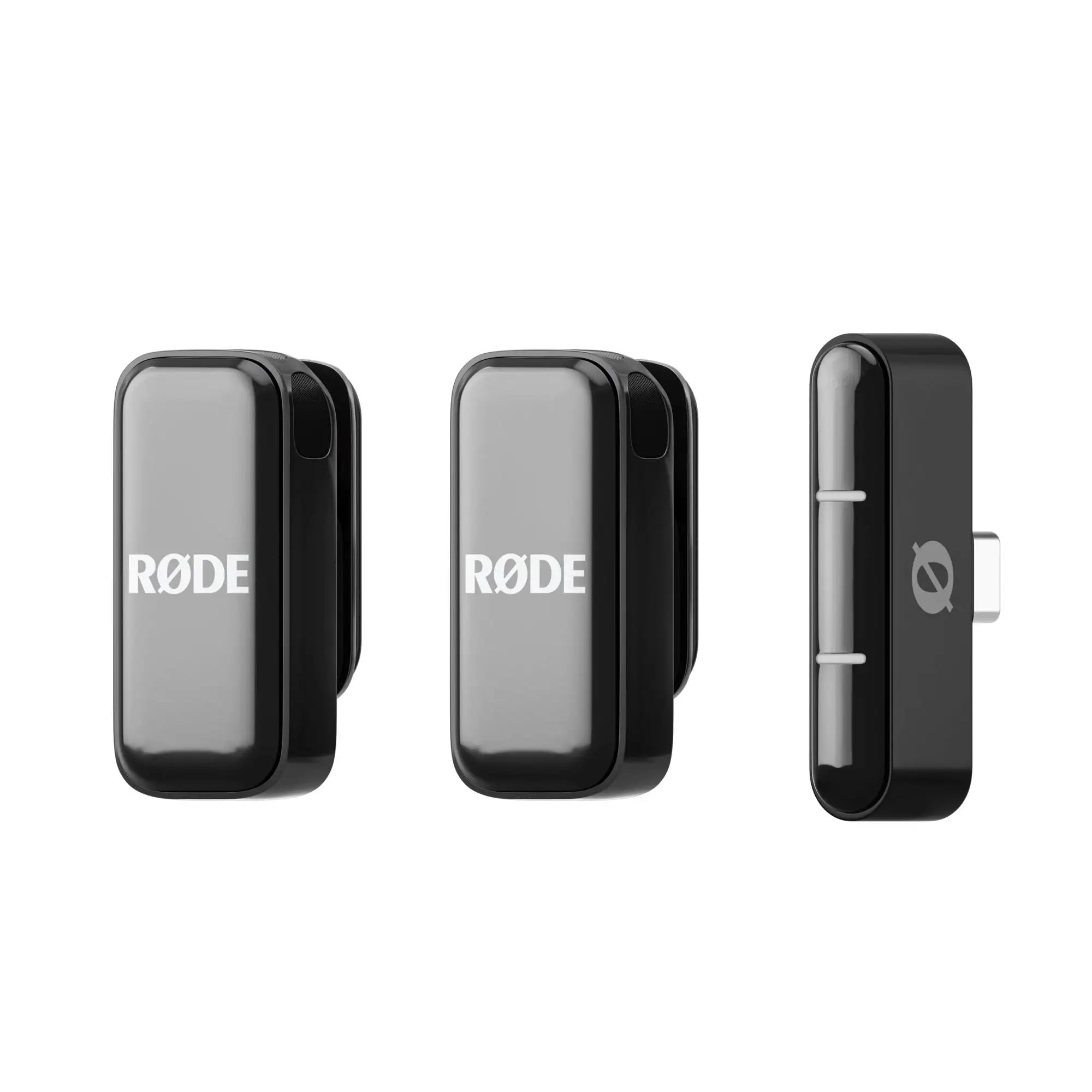
Maono Wave T5 vs RODE Wireless Micro - wireless microphone comparison
When comparing the Maono Wave T5 and the RODE Wireless Micro, it is worth moving away from general marketing use cases and focusing on the technical aspects of design, transmission, and audio signal processing. Both systems fall into the category of compact wireless microphones, but they were designed with a clearly different engineering philosophy.
Maono Wave T5
uses a classic transmitter–receiver architecture, in which the audio signal is sampled, converted to digital form, and transmitted wirelessly in the 2.4 GHz band. This solution enables stable transmission with a low level of interference while maintaining relatively low latency. The characteristics of the microphone capsule have been tuned for speech intelligibility, with a slight boost in the midrange, which favors voice recording in acoustically uncontrolled environments.


RODE Wireless Micro
is an even more integrated design, with an emphasis on automatic signal management. Audio processing takes place largely inside the system, using built-in level control and filtering. From a technical point of view, this means less user intervention in recording parameters, but also limited options for manual control of dynamics or tonal characteristics. The audio path itself is optimized for mobile recording, with a clear priority on signal stability.
Differences
Differences are also visible in the way power management and communication with the recording device are handled. Maono Wave T5 offers a more classic approach, where the receiver serves as an intermediary between the microphone and the recording source, which allows for broader hardware compatibility. RODE Wireless Micro reduces this stage to a minimum, integrating directly with the end device and simplifying the entire signal chain.
Operating characteristics

From the standpoint of technical quality, both systems provide stable digital audio transmission, but their operating characteristics are different. Maono Wave T5 gives the user greater control over the final audio material and is better suited to more complex recording setups. RODE Wireless Micro is a highly optimized solution in which most technical decisions have been moved to the level of electronics and software.
Summary
In summary, the comparison of Maono Wave T5 vs RODE Wireless Micro comes down to a choice between a flexible wireless system with a classic architecture and a maximally simplified solution in which the audio path is automated and subordinated to mobility. These are two different approaches to the same technology, aimed at users with different technical requirements.

Satechi Slim EX3 vs Satechi Slim X3 - A Comparison of Wireless Keyboards
The Satechi Slim EX3 and Satechi Slim X3 are two wireless keyboards with a very similar design, but each is tailored to a slightly different user. The EX3 is a more versatile model with more modern connectivity options, while the X3 is better suited to the aesthetic and workflow typical of Apple users. At first glance, the differences don’t seem significant, but in everyday use, it quickly becomes clear that these are two quite different approaches to the same category of hardware.

GravaStar Mercury X vs Keychron M3 - A Comparison of Wireless Mice
The market for wireless gaming mice is highly polarized today. On the one hand, there are models designed to keep weight to an absolute minimum and minimize response time. On the other hand, there are more versatile models, designed to perform well not only in games but also at work, with a laptop, and in multi-device setups...

Maono Wave T5 vs RODE Wireless Micro - wireless microphone comparison
When comparing the Maono Wave T5 and RODE Wireless Micro, it is worth moving away from general marketing applications and focusing on the technical aspects of design, transmission, and audio signal processing. Both systems belong to the category of compact wireless microphones, but they were designed with a distinctly different engineering philosophy...
